 By
By 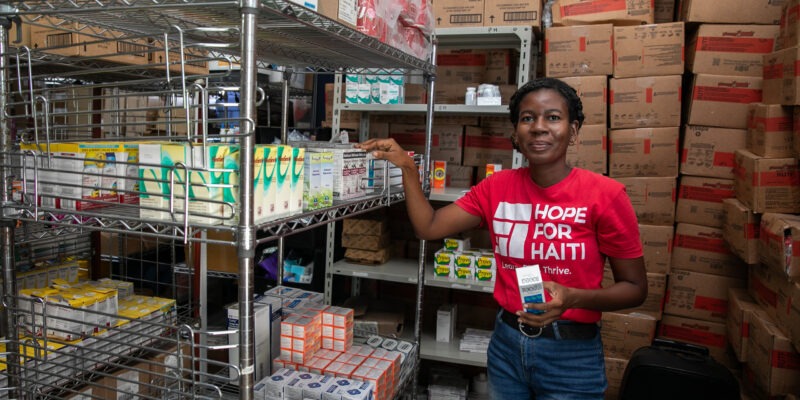
This post is also available in: Español (Spanish) Kreyòl (Haitian Creole)
Across the Caribbean, traditions of giving have long been rooted in something deeper than financial contributions. They are grounded in relationships among families, neighbors and communities that share a commitment to build a better future together.
“Caribbean people are about family, they’re about relationships, they’re about history, they’re about co-creating the future, and they’re about legacy building,” said Carla Thompson Payton, chief strategist and impact officer at the W.K. Kellogg Foundation (WKKF).
In Haiti, community-led philanthropy shows up in many ways and is often the first type of response when challenges arise, from neighbors pooling their resources to build a road to farmers making locally grown food and seeds available for their communities.
Shifting power and perspective
In February 2026, WKKF partners from Haiti and others across the region gathered in Kingston, Jamaica, for the Caribbean Philanthropic Alliance’s Future Forward convening. Conversations focused on how to bring more resources into Haiti and how to leverage those resources in real partnership with communities to increase local ownership and staying power.
At the center of that conversation was a simple but profound idea: Lasting change requires trust.
“Change happens at the speed of trust,” said Dana François, program officer at WKKF. “It doesn’t happen at the speed of coercion. It happens once relationships are established.”
What it looks like when communities lead
Across Haiti, that shift is already underway.
In rural areas, farmers and local organizations are building agricultural systems that support rural families financially while also increasing food sovereignty for children and the broader community. What began as disparate efforts has grown into networks that serve thousands of farmers and strengthen local economies.
Elsewhere, communities are organizing to meet their own needs by mobilizing their resources, labor and ideas to create solutions that reflect their realities.
“They put their money together, their hands together. …They built it piece by piece,” said Guerda Nicolas of Ayiti Community Trust, describing a road built by community members. “It shows that…they are not just waiting. They are moving forward with their own ideas.”
At a larger scale, Haitian-led collaborations are demonstrating what coordinated, locally driven systems can achieve.
“You have over 16 organizations working together toward one vision. …Haitian farmers selling and feeding Haitian children 100% locally produced food,” said François, describing the Haiti Food Systems Alliance, a growing food systems effort. “Led by Haitians, shaped by Haitians for Haitian futures.”
The role of philanthropy in a community-led model
For funders, this model of philanthropy means investing in relationships and supporting long-term systems rather than short-term projects. It also means recognizing that communities hold vision, bring knowledge, expertise, experience and solutions that cannot be replicated from the outside. When philanthropy listens, and accompanies that leadership, it becomes more effective.
“I actually don’t like the word ‘impact’ in philanthropy because ‘impact’ means something that we forcibly do to someone else,” said Karen Ansara, founder of the Ansara Family Fund and board chair of the Network of Engaged International Donors (NEID). “Rather, we should be saying we want to increase your initiative, your leadership, not our impact.”
Thinking in generations, not grant cycles
There is growing momentum across Haiti and the Caribbean as networks of organizations align, communities strengthen their own systems, and partnerships form in new ways.
These are the “pockets of hope” that point toward a different future: one where children, families and communities thrive because they are shaping that future themselves.
For funders and partners, the path forward is clear: rightsizing power, building trust and investing in the institutions and leadership that already exists.
In Haiti, that long view can best be described using a simple metaphor.
“All of us have a mango tree…because somebody planted that mango,” said Guerda. “The question is…to what extent are we building mango trees so the next generation can eat?”


Comments