 By
By The first weeks after birth are both tender and overwhelming. There is the joy of welcoming a new member of the family — holding your baby for the first time, feeling tiny fingers curl around yours. And there is the relentless rhythm of it all: feedings every few hours, endless diaper changes, soothing cries at 3 a.m., all while a mother’s body is still healing.
During these early days and weeks, families are expected to learn and manage so much, often with little sleep and even less energy.
For both parent and baby, these weeks are critical. A newborn’s weight gain can stall. A fussy baby might be fighting an infection. For mothers, warning signs like rising blood pressure or sudden swelling can go unnoticed until they become emergencies.
Early attention can make all the difference. Yet too often, the closest hospital is miles away, insurance falls through, or there’s no system in place to check in after birth, allowing serious risks to go undetected.
In the United States, maternal mortality is higher than in any other high-income country, and nearly two-thirds of maternal deaths occur in the weeks after birth — exactly when follow-up care is hardest to access.
For families in Louisiana, the state with the highest maternal mortality rate in the country, the gaps are even wider: more than a quarter of parishes have no maternity care providers at all. And the health system continues to fail Black mothers most severely — they account for 37% of births but 62% of pregnancy-related deaths. Louisiana’s Pregnancy-Associated Mortality Review Committee has found that the vast majority of pregnancy-related deaths in the state were preventable, meaning there were missed opportunities for intervention at the clinical, community or systems level.
The issue is gaps in access, follow-up and early intervention — and a system that fails to consistently connect families to care in the critical weeks after birth. Prevention requires the right support at the right time.
A knock on the door
After giving birth to her daughter, one New Orleans mother began feeling feverish and exhausted.
“I thought initially maybe I was coming down with the flu,” the mother recalled. “I didn’t think it had anything to do with postpartum.”
During her Family Connects home visit, the nurse walked this new mother through warning signs to watch for after delivery. That conversation helped her recognize that something wasn’t right — and prompted her to seek care immediately. At the hospital, doctors found part of the placenta had been left behind, causing a dangerous infection.
“If I didn’t have that information from [the nurse], I honestly don’t know where I could have been,” the New Orleans mother said. “She definitely kind of saved me.”
Family Connects New Orleans (FCNO) makes support like this available to every family who gives birth and lives in Orleans Parish — no income limits, no referrals, no risk screening required.
Launched by the New Orleans Health Department in 2023, the evidence-based model offers free home visits to all families who deliver at Ochsner Baptist or Touro hospitals. The visits provide health screenings, mental health support and connections to community resources brought directly to families’ homes. Since launching, FCNO has made more than 1,500 home visits across Orleans Parish.
Follow-up care often requires time off work, reliable transportation, child care and insurance that doesn’t lapse. Those hurdles can make routine postpartum visits difficult to access — even when complications are common. Family Connects removes those barriers. Enrollment begins at the hospital after delivery, one less thing for new parents to navigate on their own. A few weeks after the family leaves the hospital, a registered nurse makes a home visit.
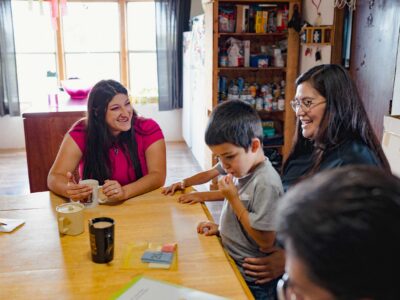
Visits can last up to two hours. Nurses check how the baby is feeding and gaining weight. They ask the birthing parent how they’re healing, physically and emotionally. They help families access healthy food, connect them to programs like WIC and SNAP and sit with them to complete paperwork. They review safety basics like safe sleep and smoke detectors. If partners or grandparents are present, nurses check in with them, too.
Jordan Vaughn had been home with her newborn for a few weeks when a nurse from Family Connects knocked on her door. “It almost felt like a family member was visiting,” Vaughn recalled. “Like a home concierge medical checkup.”
While there, Vaughn said the nurse weighed the baby, observed a feeding and walked through practical stuff like breastfeeding, milk storage and pumping. Before leaving, the nurse gave Vaughn a milk chiller and a book for her daughter.
“A lot of times postpartum, it’s all about the baby,” she said. “I was like, oh, you want to talk about me?”
She paused. “Just feeling seen — I think that’s the best way to phrase it.”

A program designed to work
Too often, programs that promise help come with barriers: complicated applications, income limits, long waits, fear of judgment. Family Connects was designed differently.
There are only two requirements: deliver at Ochsner Baptist or Touro hospitals and live in Orleans Parish.
Family Connects does not wait for families to prove need. It starts with the belief that every newborn and every parent deserves support — and builds flexibility into the system from the start. The City of New Orleans funds the program’s operations, while the W.K. Kellogg Foundation supports evaluation, outreach and policy advocacy to help the program reach more families.
Backed by research, the program uses real-time data and community partnerships in New Orleans to identify gaps as they appear — from breastfeeding challenges to mental health concerns — and connect families to help quickly.
Early findings from an evaluation led by Tulane University show that the approach is both effective and cost-saving.
in the
9
months after birth
New Orleans birthing parents who received home visits were
MORE LIKELY
to attend postpartum checkups, and when hospitalizations occurred, they had fewer repeat stays. In that same period, Medicaid spending for mothers and infants who participated in Family Connects New Orleans
decreased by
28%
an average reduction of
$1,526
compared to non-participants. Research on a similar program in North Carolina found a
$3.17
reduction
Family Connects shows what’s possible when postpartum care is treated as a public good — universal, preventive and built into the system rather than left to chance. When communities invest early and consistently in families, they prevent crises, reduce costs and build healthier futures for children across Louisiana and beyond.
Explore more
- Family Connects: https://familyconnects.org/
- Maternal mortality in the U.S., Commonwealth Fund: https://www.commonwealthfund.org/publications/issue-briefs/2025/oct/maternal-child-mortality-how-do-us-states-compare-internationally
- Louisiana maternal health data, March of Dimes: https://www.marchofdimes.org/peristats/reports/louisiana/report-card
- Deadly disparity: Data on Louisiana’s Black maternal health crisis, The Tulane Hullabaloo: https://tulanehullabaloo.com/70798/data/print-maternal-mortality-rates/
- Randomized controlled trial of Family Connects, National Library of Medicine: https://pmc.ncbi.nlm.nih.gov/articles/PMC7061922/




Comments