 By
By 
Photos by Isabel Lopez Slattery
Evidence-based hiring practices help employers make more accurate hiring decisions by replacing “gut feelings” with data-driven assessments of candidates’ skills and potential.
Programs utilizing such practices have reduced turnover and shortened hiring times.
Employers gain stronger, more committed workers, while job seekers — including those without traditional degrees — get more equitable access to career opportunities, empowering them to better support their families. The approach also builds a more inclusive workforce, proving that objective, research-based hiring can benefit both organizations and the communities they serve.
Rethinking hiring: Removing bias to build a stronger workforce
“We saw that as an opportunity to try something different … to try what we used to call the evidence-based selection process,” said Shana Lewis, vice president of talent acquisition and workforce development programs at Trinity Health.
Trinity Health began by shifting practices.
“At the time we weren’t really after increasing the diversity of our workforce, although that’s always been a lens for us at Trinity,” Lewis explained. “But we were more focused on not having an adverse impact on certain populations through the use of this process.”
Put simply, Lewis and her team set out to remove bias from the hiring process, a longstanding challenge for companies. Doing so not only improves talent attraction and retention, but also directly impacts a company’s bottom line.
“And when you don’t have a fair objective process in place, at the very beginning of the selection process, some of that unconscious bias can creep in.”
According to a 2006 study from the Journal of Organizational Behavior and Human Decision Processes, a job interview is the perfect setting for subtle cues and perceptual and judgmental biases to affect decisions in the hiring of an individual. Subtle cues — like having an accent when speaking English — have an adverse effect on whether an individual is hired. Minimizing some of that unconscious bias was the goal for Lewis and her colleagues.
“We’re human beings,” Lewis said. “And when you don’t have a fair, objective process in place, some of that unconscious bias can creep in.”
Redefining qualifications: Focusing on skills over credentials
Implementing the evidence-based selection process meant revamping the organization’s hiring process. Instead of solely focusing on a resume, Trinity Health began using an assessment, two interviews and a reference check to come up with one score for an applicant.
“We do look at resumes, but we also know people are not resume writers. … Most people that will apply, that have any level of work history or any applicable experience to the role, we’ll set up a phone call with a member of the talent acquisition team,” Lewis said.
The phone calls help provide a holistic view of the job applicant — one the hiring team couldn’t have gleaned from considering the candidate only through their resume.
“So, we’ve eliminated, in some cases, degrees that were a part of a job description in the past that we realize now aren’t really relevant to the role,” Lewis added.
This change helped Trinity Health consider candidates who didn’t have a degree from a higher education institution but did have the experience to match that educational background. They’ve also started to flip their process and consider candidates who only have 20% of the experience they are looking for instead of 80%.
“These individuals are motivated to gain that training, so we ask ourselves what we can do to ensure that they are successful in a role where they will need that additional training,” she said.
This model has proved successful at helping Trinity Health improve their talent attraction and retention metrics, reducing their time to hire by 16% and their first-year turnover by 23%.
In addition, after implementing the new process, the percentage of people of color being hired by the health system increased from 18% to 38%.
Tracie Coffman, program officer at the W.K. Kellogg Foundation (WKKF), said it was important to explore how to scale Trinity Health’s success.
“How can we show that this isn’t just a Trinity Health program, that it’s something that actually multiple employers could do in multiple sectors, that it doesn’t just live here,” Coffman said.
By partnering with the Doug & Maria DeVos Foundation, WKKF funded West Michigan Works! to use the evidence-based selection process Trinity Health developed in other sectors. Today that has grown into a program known as HireReach, and it focuses on helping employers across the region implement evidence-based selection to improve the accuracy of and reduce bias in candidate selection decisions.
“The process to assess people’s skills, and then to assess the job and what skills the job actually needs, removed a hiring manager’s gut feeling about whether or not a person fits into the role, because there were now more objective measurements of whether or not they have the skills to fit into the role,” Coffman explained.
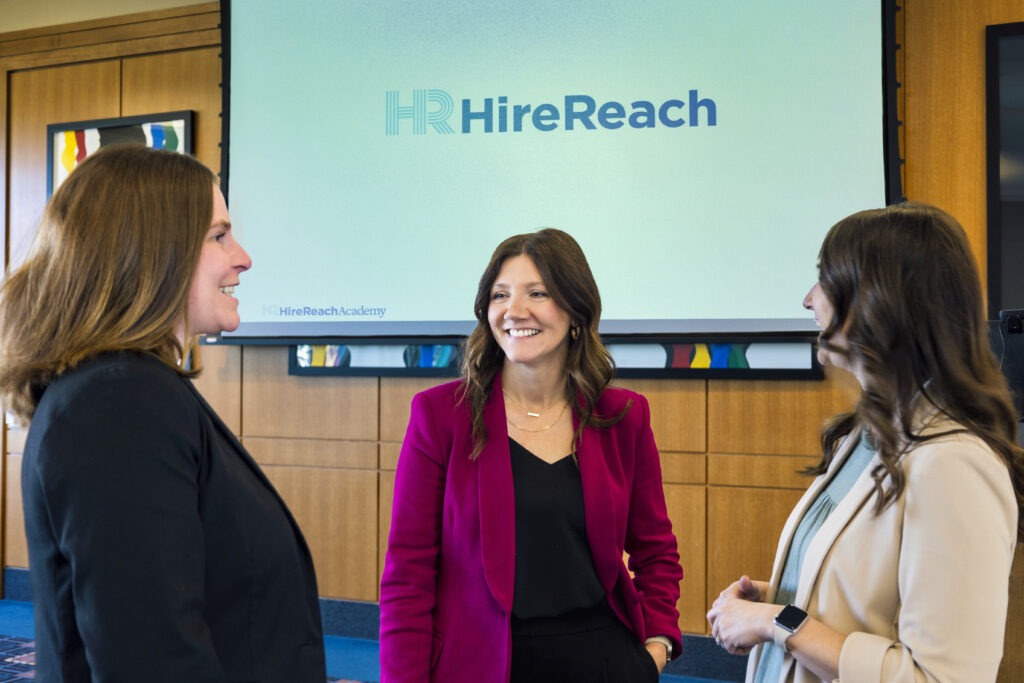
HireReach project manager Marlene Brostrom (center), with two attendees at a 2023 conference.
Rethinking fit: How HireReach helps employers see potential beyond the resume
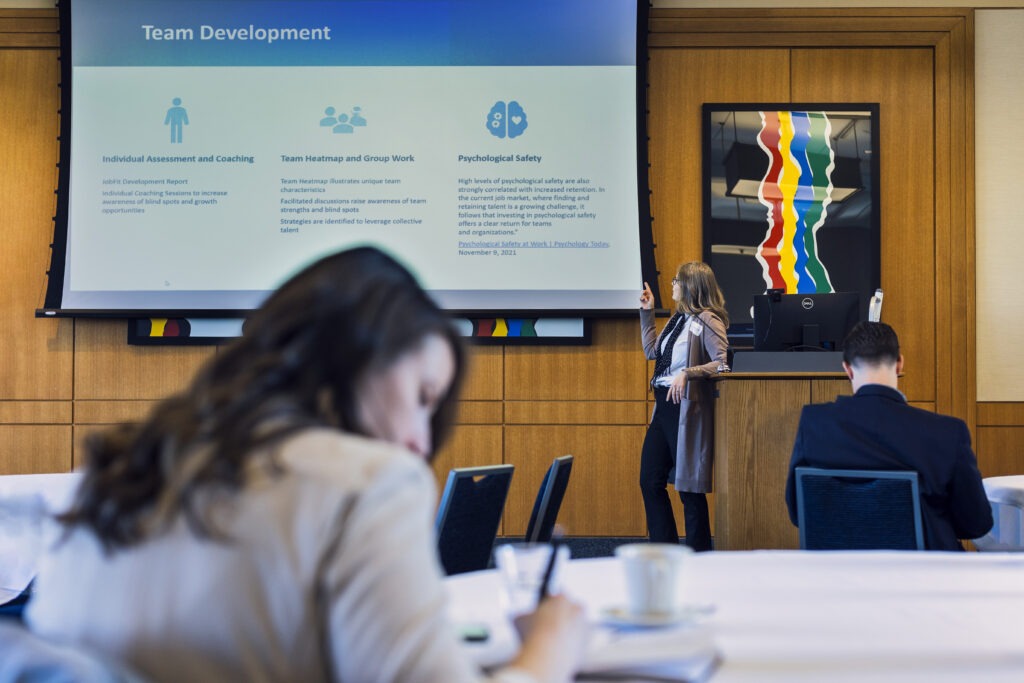
At HireReach, project manager Marlene Brostrom strives to provide employers a broader perspective of a potential applicant. Using personality and cognitive assessments and interviews focuses on understanding the applicant’s behaviors instead of just their previous job experiences.
“We do not advocate for cutoff scores. Instead, we collect data on the applicant’s personality to really see how good of a fit this person is compared to the job and then determine what competencies we really need for someone to be successful at that job,” she said.
Brostrom says their goal is to help employers see that the right fit for a role may be found in candidates they once overlooked.
“Because the City looked at [the applicant’s] personality and their skills, they realized they were the perfect fit for the role”
The City of Grand Rapids was one of the first organizations outside of Trinity Health to use HireReach to rethink their hiring practices, testing the program in filling a customer service clerical role at the city. Through HireReach, the city hired a candidate who primarily had experience as a bus driver and likely would not have received the job through traditional hiring practices. “But because the city looked at [the applicant’s] personality and their skills, they realized they were the perfect fit for the role,” Brostrom said. “This individual spends countless hours talking to customers as a driver, they were already adept at multitasking.… inevitably they already had the skills needed for this customer service role.”
Desireé Frugé, director of human resources at the City of Grand Rapids, said implementing this model was about improving the fairness of the hiring process. Before using HireReach, Frugé says they asked applicants to take a civil service exam to determine if they had the skills necessary for the job — but often these tests weren’t written at the educational level the job description required.
“If we say this is a high school diploma job… are we really testing at that level?” Frugé explained. “I think there’s just been a group of people that’s been boxed out of employment,” Frugé said. “And now I think we have the tools to make employment decisions and to set people up to be successful.”
Through HireReach, Frugé says she wanted to get away from hiring a candidate because they make the interviewer feel good. They now use cognitive assessments to determine how closely the candidate aligns with the position.

Michelle Nichols-Eddie (left), assistant director of human resources for the City of Grand Rapids, with Desireé Frugé, director of human resources.
In addition, the city uses HireReach to help employees advance to higher paying positions. “We are using career coaching tools learned through HireReach to help support employees in their current roles or find better fits for them within our organization,” Frugé said.
As Frugé is getting ready to retire from her position as human resource director, she says bringing on HireReach to the City of Grand Rapids is one of the decisions she’s most proud of in her decades-long career.
To date, 55 organizations, including businesses, corporations, nonprofit organizations and several government entities in and outside of West Michigan, have undergone HireReach training. Of those, 100% have implemented at least one of the practices they learned, while 75% have implemented robust changes based on the training.
To learn more about HireReach, visit https://www.hirereach.org/.



Comments