
 By
By 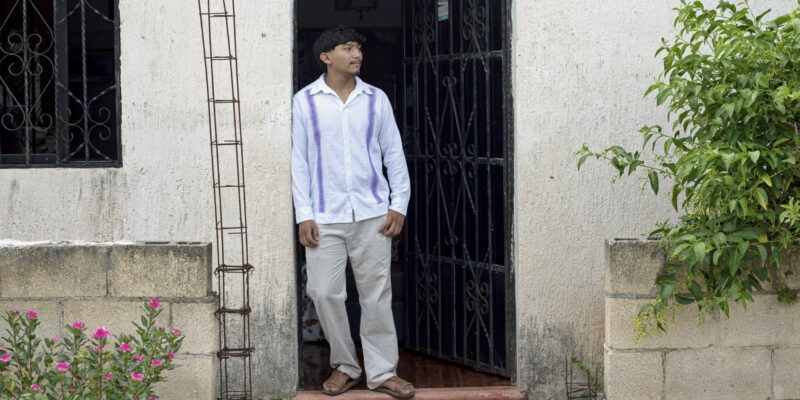
This post is also available in:
This post was originally published on Gatopardo.com
Meet William Leandro Chan Chan. Through the knowledge passed down by his grandmother, what he learned from the civil association Ciencia Social Alternativa, Kóokay, his mother’s embroidery, and his language, which reclaims the act of seeing the world in Maya, William learned something else: ignoring human rights means normalizing violence.
Text: Cecilia Abreu
Photography: Lilia Balam
Voice in Mayan: Mali Hau Ucan
The Yucatán plain covers an area of 39 524 km², of which 103.4 km² are within the municipality of Mayapán, home to the (unofficially) last great Maya capital and to William Leandro Chan Chan.
In this community, known as the Flag of the Maya, people like William still live today, proudly raising the banner of Maya identity as both present and future.
William’s openness to the world and the clarity he displays at just 18 years old are remarkable — strikingly different, it occurs to us, from his hometown, which, as a capital of the Postclassic period, was enclosed by walls. With a calm voice and a willingness to listen, he has come to understand something that many people may never grasp during their time in this world. Knowing something is not enough; you have to find a way to communicate it, share it and do so with respect.
His culture is not something he was taught — it runs through his veins. He learned Maya from the cradle. Or rather, by the time he became aware of the language — not the tongue — coming from his grandmother’s mouth, he already understood it. His only lesson was realizing that he could communicate with her almost instinctively.
Those words, that code, that syntax, that way of seeing and inhabiting the world have always been a source of pride. His voice carries the culture into which he was born, a bridge of communication with his grandmother, his family and even his friends. Still, William acknowledges that he encountered stigma along the way. He was singled out for speaking Maya, but they never silenced him. “People make fun of things they don’t know, but once you help them understand even a small part of the history behind the language, they’re like, ‘Wow, I didn’t know that,’” he explains.
It would be easy to portray William as a kind of defender of the Maya stronghold. As a member of the resistance. Yet we are surprised to find that his outlook is something more natural. His culture is not an ancient jewel in need of preservation. The young man does not make speeches; he joyfully expresses his identity because he relies on it to thrive in today’s society and draw strength from his community. His culture is an asset.
But like everyone else, William needed a push. He needed to realize that he was part of an entire generation of young Maya people who simply move forward and claim space without asking anyone’s permission. They draw on their ancestral culture to adapt to dynamic, multilingual environments that are increasingly open to outside influences and less rigid, while maintaining connections with their elders.
For William, it all started with a gesture. Years ago, when he was still in high school, he saw that his cousin was part of the recording of a video. In it, various types of violence were interpreted and recognized. Today he is the participant, not only in videos, but also in workshops and training processes, both in learning and teaching.
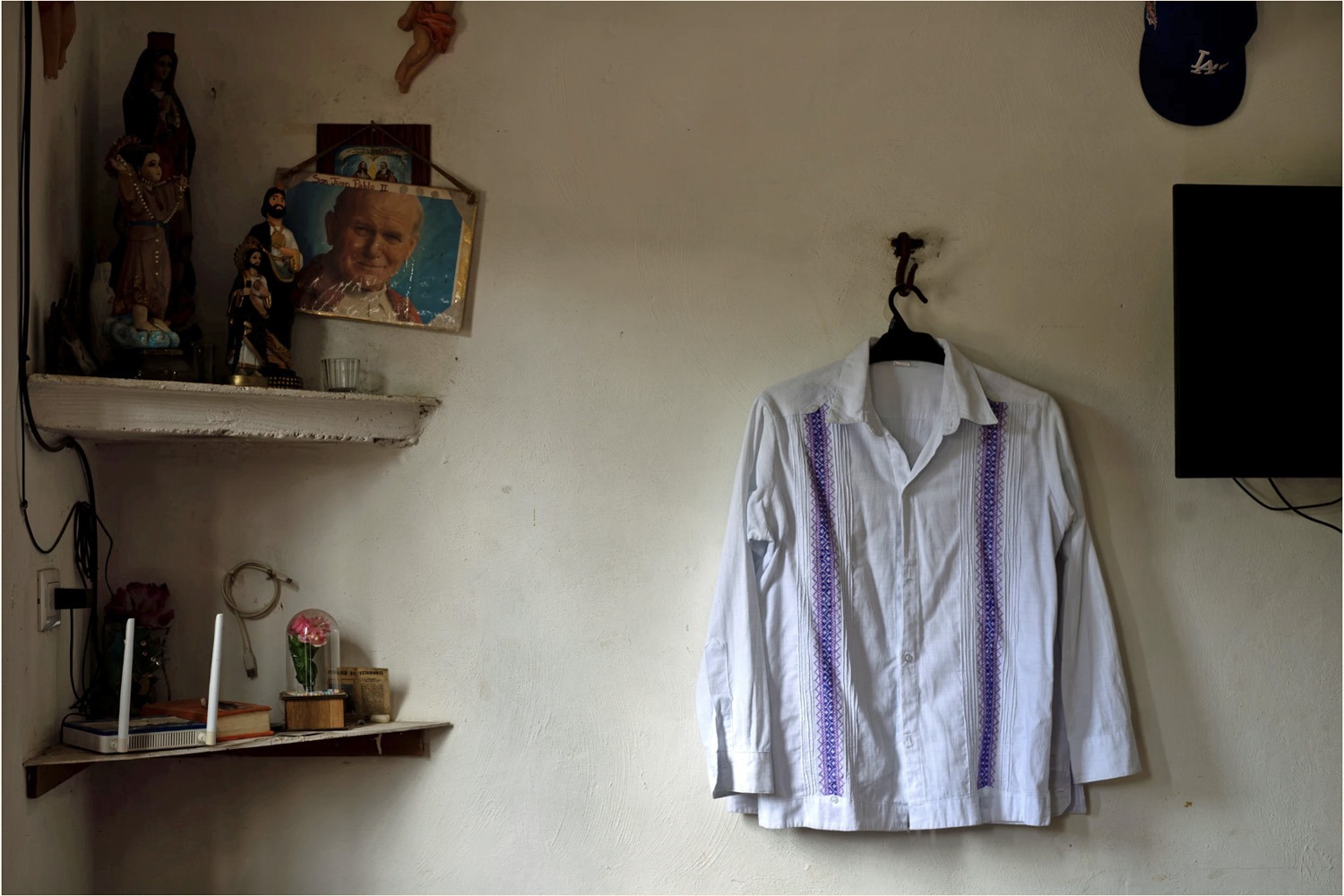
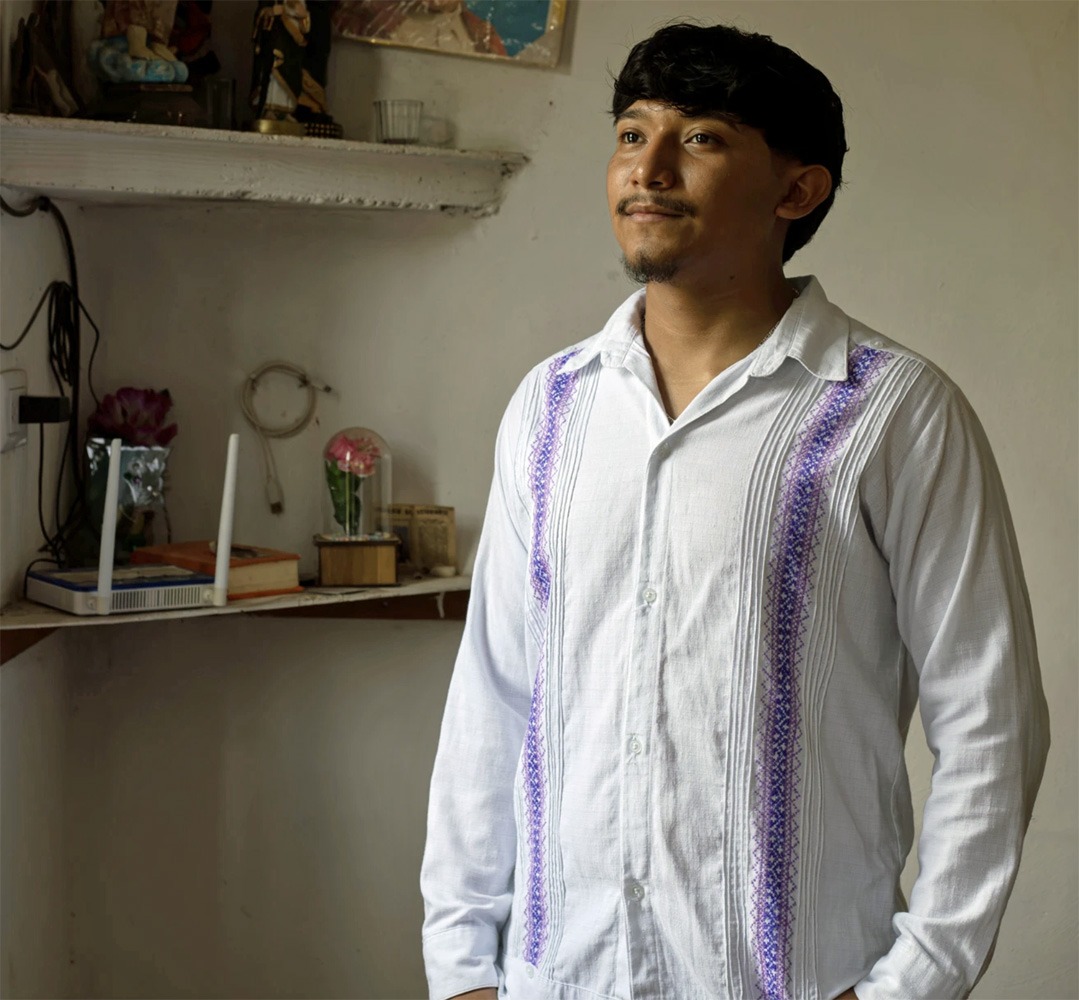
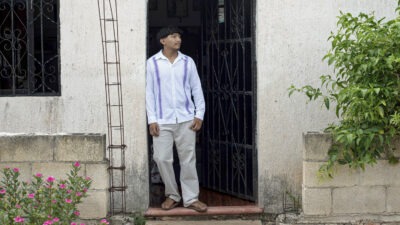
On this mid-July day, William stands tall and upright; he wears a guayabera with purple cross-stitch embroidery with pride because his mother cared for every detail of the little crosses that make up the fabric and because it manifests his culture. He wears this garment (the last one his mother could weave, as she no longer embroiders because she cannot see the thread crossing the fabric well) in front of his nieces and nephews, who watch amused as photos are taken of him to illustrate this article.
But he doesn’t let time go to waste. He asks his nieces and nephews, “Do you know your rights?
The kids tell him yes, but when he asks them what they are, they don’t know what to answer. William continues. With the kind of dedication with which his mom embroidered her last guayabera, he tells his cousins about their right to education, their right to food…
William speaks with conviction. He has thought the subject through. He learned it thanks to the work programs of Ciencia Social Alternativa, Kóokay, a civil association for which his cousin recorded those videos on making violence visible, and which has helped him embrace his Mayan identity.
It was at his high school, Colegio de Bachilleres del Estado de Yucatán (Cobay) Teabo campus, about 12 kilometers from home, that he took his first human rights workshops with Kóokay. They had a great impact because they taught him to internalize a saying that is often repeated emptily, without consequences: There are no inferior people.
William explains that over time he was invited to participate in more activities; some far from home, almost 100 kilometers from the place that saw him speak Maya with his grandmother for the first time, in the Yucatecan capital. Thus, he joined a group of young people who collaborated with the organization by contributing ideas, devising ways to make other young people have fun while learning about their rights, so that the information wouldn’t “go in one ear and out the other.”
It’s not that this young man didn’t have a notion of his rights before. He simply didn’t identify them so clearly (“I knew the word, but not the real meaning”). To make them his own, it was necessary to travel the path of maturity and, ultimately, of self-awareness.
”Ethnic-racial” was one of those concepts that appeared in the card games usually used in the school’s early ‘dynamics’, a term he had to name, in whose description he would get stuck. Not anymore. For some time now, it has been useful for him to reach reflections such as: “If someone is against my culture, I embrace it with more pride.” Before, he knew racism in the abstract, but he hadn’t recognized that it could be expressed as a concrete form of discrimination, the kind faced by people in his community.
William elaborates: “Knowing so much that everyone is against that makes you feel prouder of your roots (…) I feel like a joy comes over you saying, ‘I can do this, and other people can’t do it,’ and it’s a motivation.”
Today he doesn’t care, for example, if someone criticizes that every May 13 he puts on his sandals, his traditional guayabera — the one without purple embroidery — and goes out toward the celebration in honor of the Holy Christ of Love, celebrated in his town. But that was only the first step. What is the use of knowing how to put someone else’s perspective into focus if you cannot share your knowledge and thereby influence your community? His culture — specifically, his language — has been a kind of leadership school for him.
William doesn’t lack opportunities to speak Maya. For a while, he participated in Tu Click radio, where he spoke about human rights in Maya. And although he had to leave the project a year ago to prioritize his studies, he still doesn’t rule out the idea of returning to it. A window may open for him to do so, now that he is taking a year off to prepare for admission to the Faculty of Architecture in Mérida.
Between the knowledge bequeathed by his grandmother, the learning acquired with Kóokay, his mother’s embroidery, and his language that pronounces rights in Maya for an audience, William learned something else: Ignoring rights is normalizing violence. He finds it important to share what he has learned because he recognizes that previously he saw certain behaviors as normal, and today, looking at them through the filter of his knowledge, he identifies violence. Adult centrism is one of the ones he finds most normalized. It refers to the line of thought that grants absolute power to the adult, leaving the minor on the sidelines of decisions — even those related to their own life. William believes it is very easy to confuse this type of violence with due respect toward older people. However, the young man has learned more than just rights. He has learned empathy and composure. He has experienced adult centric violence many times, and he has made a decision: He will not remain silent, but he will not fight with those who do not know how to listen either. He tries to have an impact on other people, but he chooses when to speak with someone and does so assertively.
Everything he has lived and learned has sown in William the conviction that assuming his rights must be the hallmark of his way of acting. He cannot act as he did when he didn’t know them, because rights belong not only to him, but also to everyone else.
”Knowing helps you realize the things and actions that you do or used to do (…) It’s true that you can’t go back and improve what you did, but you can make a big change by starting to do it from now on. I believe change happens when you decide to do it,” the Mayan youth summarizes.
“What do you do differently now?”
“Before, I was one of those ‘act first’ […] But now I try to analyze situations and try to understand better.”

Despite the pride with which he wears his traditional attire, William admits he is young and also wants to wear more modern clothes. That’s why he leaves his traditional clothing for special occasions. But his culture, unlike clothing, cannot be put on and taken off; he carries it with him always, honoring it at every moment.
While he talks about the loss of his language, a motorcyclist pulls up almost at his front door, his motorcycle horn sounds, and the neighbor comes out to attend to him. They speak in Maya, both of them. Evidence of what William was describing: One can argue whether Maya is losing strength in cities, but definitely not in towns. Not in his town. But the broader context is inescapable. Data from the National Institute of Statistics and Geography (Inegi) indicate that the Mayan-speaking population went from a total of 537,618 people in 2010 to 519,167 in 2020. Despite the efforts of many people like William to move through the current world with the words of their ancestors, fewer and fewer people speak to them.
The young man has a strong opinion on the matter, and a sense of responsibility.
“It is very sad, because we could do something to remedy that in the future there are no people speaking Maya; we could be teaching, conversing with different people, making programs in Maya, because as Yucatecans it is something that distinguishes us, and if it were to be lost it would be like losing a part of us, of our identity.”
And that is precisely what his family sows and hopes to harvest: his older sister and brother are teachers of the Maya indigenous language. “I feel that idea has always been in my family: Feeling proud of who we are…If there are still young people who speak Maya and for some reason push it aside, let them take the initiative to keep speaking it and taking pride in it, so they can continue with that heritage left to us by our ancestors.”
William’s echo resonates in teacher Isabel Eloísa Cerón Ramírez, a professor at Cobay, where he studies. Even though she did not see the beginning of the young man’s transformation, she has known him for two years, when he took his second and third years of high school, and describes him as “a respectful, responsible boy, proper with his ideas and his way of expressing them.” She thinks these values have been well-grounded from home, and Kóokay has been a link.
This organization initially worked with two groups of 40 students at the campus. Then they selected a group of eight young people to boost their leadership attitudes and contribute to their training. One of those eight young people, of course, was William. They ended up teaching the topics they learned at their school. The teacher understood that by sharing information among peers, it is even possible to reform behaviors that are culturally deeply rooted, such as machismo and adult centrism, which William knows so much about.
Now, the journey continues, not only for William, who is beginning a new stage and will put what he has learned into practice in new spaces and with new challenges, but also for the 15 students in the program, among those who have already graduated, like William, and those who have just entered the campus. Teacher Cerón has a wish:Tthat the youth are formed with full knowledge of their rights, and that, if possible, the civil association that has contributed so much to this reaches more young people.

Comments